
Social Teachings of the Church
Social Teachings of the Church
Anne Freemantle
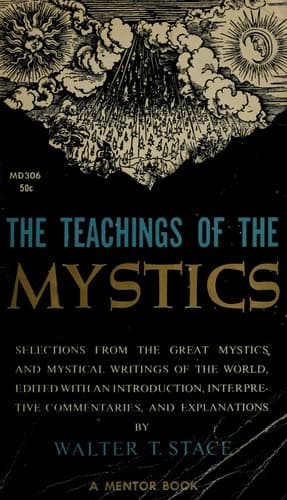
being selections from the great mystics and mystical writings of the world.
W. T. Stace · Jan 1, 1960 · 240 pages · eng
Catalog 0.0/10
Playlogs —
"The Teachings of the Mystics is a 1960 work of popular philosophy by the Princeton philosopher Walter T. Stace that lays out his philosophy of mysticism and compiles writings on mystical experience from across religious traditions. The book’s comprehensive selections met with broadly positive responses. An introductory chapter lays out Stace’s philosophy and psychology of mysticism. He defines the principal characteristic of mystical experience as "the apprehension of an ultimate nonsensuous unity in all things",and differentiates it from occult, parapsychological phenomena, visions, voices, and anything "misty" or vague. Stace distinguishes between two types of mystical experience: extrovertive mysticism experiences unity in the world through the physical senses, while an introvertive type experiences unity in the self. Stace sees introvertive mysticism as more important and the focus of The Teachings of the Mystics. He proposes that there is a core to mystical experience, which is more basic and important than superficial differences over time and across cultures. This hypothesis can only be justified by a survey of mystics’ descriptions of their experiences – the book purports to be that. Stace chooses texts that describe mystical experience, rather than interpret or analyse it." Cited at: http://en.wikipedia.org/wiki/The_Teachings_of_the_Mystics
Loading…
Anne Freemantle
Martin Buber
Robert Lynn Brown
Charles Drekmeier
Sarvepalli Radhakrishnan, Charles A. Moore, Charles Alexander Moore
W. C. Smith
B. Benoit, L. Benoit, A. Chapman
Sadie Rose Weilerstein
Myrtle Fillmore, Warren Meyer
Donald Keene

William James
Ignatīĭ Saint, Bishop of Caucasus and Chernomorʹe, Ignatii, Ignatius Brianchaninov